
The digitalization of attendance tracking improves data reliability, accelerates processes, and strengthens organizational transparency. For HR software vendors, the success of an attendance solution no longer depends solely on the performance of its code. The real challenge is now operational.
Behind every SaaS platform lies a hardware reality. Whether the end customer opts for a mobile or fixed solution, software vendors who do not design their own devices must still be able to deploy the full solution quickly and ensure ongoing maintenance.
Choosing the right hardware partner becomes a strategic decision: it directly impacts both the user experience and the ability to scale. By relying on an integrated and simplified ecosystem, software vendors can offload hardware complexity and focus on developing and enhancing the value of their software.
The three deployment options for software vendors
When selling an attendance tracking solution, software vendors must choose between different approaches, each with distinct operational implications and outcomes.
Software-only (APK)
The vendor provides only the application. The end customer must then select and manage their own time-tracking devices. This approach creates dependency on multiple suppliers, increasing the risk of technical incompatibility between software and hardware. As a result, the user experience becomes inconsistent: one customer may experience synchronization delays, while another benefits from smooth performance, simply because the hardware is not optimized for the application.
Mobile application (App Store / Play Store)
The application is downloaded onto consumer smartphones. In this case, the environment is not controlled: employees can uninstall the app, modify system settings, or use the device for personal purposes. Additionally, the cost of purchasing and repairing modern smartphones remains high when equipping large teams. This approach is often unsuitable for demanding professional environments where devices are exposed to damage, dust, humidity, or extreme temperatures.
Hardware partnership
The vendor partners with a hardware provider to deliver a combined solution including both software and dedicated professional devices. This approach ensures a consistent user experience and equipment tailored to field constraints. However, it introduces significant challenges: hardware management falls outside the vendor’s core business, logistical complexity increases (storage, preparation, delivery, maintenance), capital is tied up in inventory, and scaling requires additional operational resources.
A hardware partnership is therefore the best option to guarantee a consistent and professional user experience, provided the partner can fully handle the hardware infrastructure.
Famoco as a deployment enabler
Famoco enables software vendors to focus on their application by handling all hardware-related constraints, offering a fully integrated ecosystem where each technical component fits seamlessly together.
A range of professional devices
Famoco provides devices specifically designed for demanding field environments:
- Famoco Square: a compact and practical terminal for mobile time tracking
- Famoco Tap&Go: Apple VAS-certified, enabling digital badge validation via smartphone wallets (Google Wallet and Apple Wallet). This NFC-based validation is 2 to 3 times faster than QR code scanning and inherently secure
- Tab 10: a rugged tablet offering enhanced readability thanks to its large display
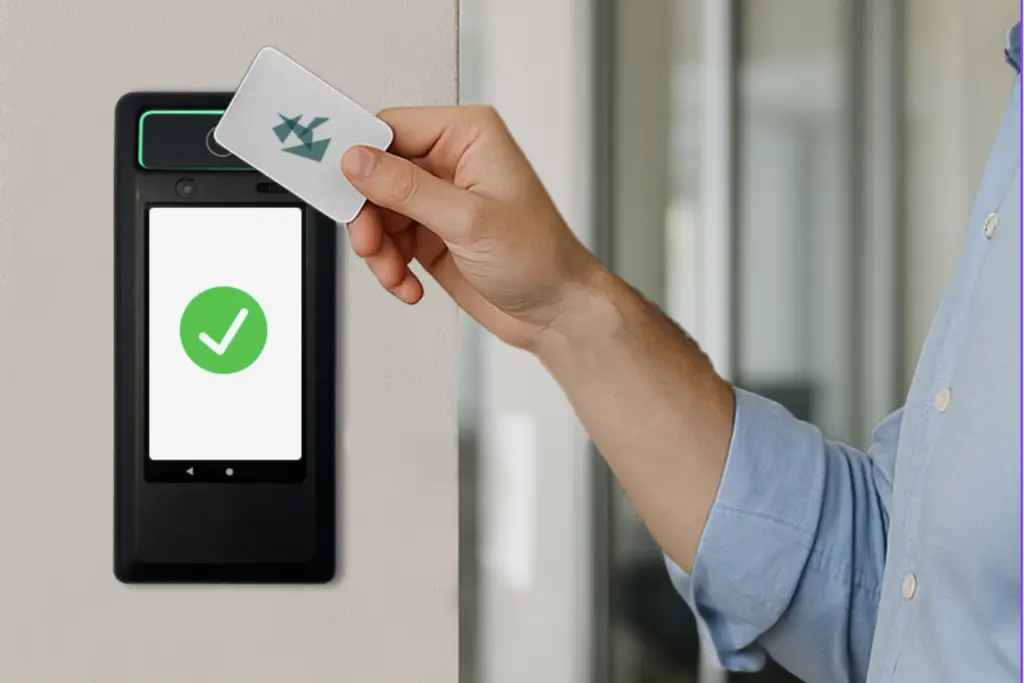
These professional-grade devices are robust and secure, featuring a front-facing NFC antenna for intuitive check-ins, flexible usage (wall-mounted or mobile), and a front camera enabling facial recognition features when supported by the partner’s application.
Integrated MDM platform for centralized management
Managing a fleet of distributed physical devices adds complexity for software vendors. To address this, Famoco provides a sovereign Mobile Device Management (MDM) platform.
This centralized system allows vendors to manage and secure devices remotely via a web interface. It enables large-scale deployment of thousands of devices simultaneously, remote data wiping in case of loss or theft, instant application updates across the fleet, configuration customization per site, and real-time monitoring of each device’s technical status. This global visibility helps anticipate failures and ensures maximum service continuity, without burdening vendor teams with time-consuming operational tasks.
Plug-and-play deployment (“Zero Touch”)
Devices are registered on the platform from the moment they are manufactured. Upon first startup at the customer site, the device automatically connects, recognizes its predefined configuration, and downloads the business application with all required settings. While traditional deployments require around 20 minutes of manual setup per device, this process is reduced to zero with Famoco. For end customers, deployment is as simple as turning the device on, no technical intervention required.
End-to-end logistics management
Famoco handles the entire logistics chain. Vendors no longer need to manage physical inventory: no warehousing, no risk of obsolescence, no capital tied up in stock. Devices are prepared upstream (connectivity setup via Famoco Connect, application installation, configuration), shipped directly to end customers ready to use, and replaced immediately in case of failure, without requiring vendors to manage returns or diagnostics.
Device-as-a-Service (DaaS): hardware as a subscription
The DaaS model allows hardware deployment through a flexible monthly subscription aligned with SaaS business models. This “order-as-you-go” approach eliminates upfront investment, adapts dynamically to changing needs (workforce growth, new sites), and ensures predictable recurring costs. The entire hardware lifecycle is managed by Famoco.
Global connectivity and data sovereignty
Technological sovereignty is at the core of Famoco’s approach. Famoco OS ensures that no business metadata is transmitted to third-party servers by restricting devices to professional use only. This secure environment prevents misuse and protects sensitive data.
Connectivity is provided through Famoco Connect, a SIM-free global solution operational upon delivery. This eSIM technology enables remote activation and automatic switching between operators for optimal coverage worldwide.
Devices also support offline mode natively. Attendance data is securely stored on the device via a Secure Element and automatically synchronized once connectivity is restored, ensuring no data loss even during extended network outages.
An alternative to fixed time clocks
In environments where installing a fixed time clock is not feasible, such as cleaning sites or locations with small teams (1 to 3 employees), Famoco offers adhesive NFC tags placed at site entrances. Employees can simply tap their smartphone on the tag to instantly interact with the application and register attendance.
Regulatory framework: why 2026 is a turning point
Attendance tracking digitalization is no longer just an administrative improvement, it is becoming a regulatory requirement across several European countries.
Germany: mandatory electronic tracking
Electronic time tracking becomes mandatory in 2026, following directives from the Federal Ministry of Labour (BMAS) and a ruling from the Federal Labour Court. This evolution requires employers to implement an objective, reliable, and accessible system for recording working time.
Non-compliance fines can reach €30,000, making Germany (Europe’s largest labor market) a key driver of demand for compliant solutions.
Spain: strict digital monitoring
Spain already mandates full digital tracking under Royal Decree-Law 8/2019. By March 2026, stricter requirements will enforce fully digital systems with individual identifiers and real-time accessibility for labor inspections. Penalties can reach up to €10,000 per employee, with fines ranging from €751 to €225,018 depending on severity.
The decline of biometric systems in Europe
Across the European Union, biometric methods such as fingerprint and facial recognition are increasingly restricted for attendance tracking due to growing concerns around privacy and GDPR compliance.
In this evolving regulatory landscape, NFC (Near Field Communication) is emerging as a trusted standard. It enables instant validation in under one second, without requiring users to open a dedicated application, while offering enhanced security, as it cannot be falsified through simple screenshots unlike QR codes. Moreover, NFC ensures full GDPR compliance by avoiding the storage of sensitive biometric data, and provides a more inclusive and future-proof alternative to systems that are now being phased out. As a result, software vendors must be able to deliver complete, ready-to-use solutions that fully align with these new European requirements. Famoco enables them to meet these challenges without diverting resources away from their core business.
Conclusion
In 2026, excellence in attendance tracking is no longer defined solely by software performance, but by how seamlessly it operates in the field. By outsourcing hardware infrastructure, connectivity, and logistics to a trusted partner, software vendors regain control over their growth. They no longer deliver just software; they deliver a complete, reliable, and compliant solution.
Ready to turn your attendance devices into performance drivers?
Our experts support software vendors in building fully integrated, turnkey workforce management solutions. Contact us to discover our ecosystem.
FAQ – Simplified deployment explained
Why is MDM essential for software vendors?
MDM centralizes device fleet management, enabling real-time updates, remote monitoring, and ensuring maximum service continuity without field intervention.
How does attendance tracking work without network connectivity?
Devices operate offline by securely storing data locally and automatically synchronizing once connectivity is restored.
What are the advantages of NFC over QR codes?
NFC enables instant, secure validation and cannot be duplicated via screenshots, unlike QR codes.
What does “Zero Touch” deployment mean in practice?
Devices are pre-configured and ready to use out of the box. Setup time is reduced from 20 minutes per unit to zero.
Can facial recognition be integrated?
Yes, devices like Tab 10 or Tap&Go support facial recognition if enabled by the software application, offering an additional layer of verification.