
Industrial sovereignty has once again become a major priority on political agendas. It is no longer limited to simply relocating physical manufacturing facilities; it now extends to the digital sphere. Recent geopolitical tensions and dependence on major technology platforms have reminded companies that they do not always retain control over the infrastructure on which their data relies.
This control is not only a matter of sovereignty or security. It also enables organizations to turn data into a genuine strategic asset, capable of optimizing operations, improving decision-making and strengthening the engagement of field teams.
The challenge is therefore no longer simply to protect a company’s data, but to regain control over it and turn it into a genuine competitive advantage.
Compromised autonomy: the hidden risks of technological dependence
One might assume that smartphone wallets will eventually replace everything. However, field realities tell a While digital transformation was expected to give companies greater autonomy and performance, it has paradoxically increased their dependence on the infrastructure of Big Tech companies.
In many professional environments, digital systems have been built without an overarching strategy, through the accumulation of heterogeneous solutions from multiple providers. This fragmentation has often pushed companies toward consumer-grade solutions that natively integrate services from dominant digital platforms. Although widely used, these tools create technological dependencies that place companies’ most valuable assets under foreign jurisdictions.
The CLOUD Act and the protection of trade secrets
One of the most critical issues for data sovereignty lies in the extraterritorial reach of certain foreign laws. Introduced in 2018, the CLOUD Act allows certain authorities to legally access data stored by companies subject to their jurisdiction, even when that data is physically hosted on servers in Europe.
For a European industrial company, this means that certain strategic data, such as logistics flows or operations carried out by field agents (including customer acquisition or the allocation of beneficiary rights), may potentially be accessible without prior notification. This legal reality, which is sometimes overlooked, raises questions about the security of an organization’s most sensitive data.
Business continuity: a critical issue
Beyond confidentiality, service continuity has become a critical concern. In an unstable geopolitical environment, a unilateral decision or sudden regulatory change affecting a cloud platform could instantly disrupt thousands of users.
In 2025, the controversy surrounding the potential suspension of the International Criminal Court prosecutor’s email account in the context of U.S. sanctions reignited the debate over organizations’ dependence on technology providers subject to foreign jurisdictions.
Beyond data centers and platforms: the device and its OS
Today, the debate mainly focuses on cloud infrastructure, data centers and hosting platforms. These topics are essential, but they cover only part of the data value chain.
Professional mobile devices should not be considered merely as smartphones, but as genuine secure production tools designed to protect the integrity of digital assets. The operating system they run on, as well as the way field activity is monitored, also play a key role.
When infrastructure relies on third-party solutions that organizations do not fully control, risks extend beyond the device itself. Organizations handle both strategic internal data and sensitive information relating to their stakeholders (e.g. customers, patients, beneficiaries, voters or partners). If this information is exposed, it can facilitate fraud and cyberattacks.
This exposure can also create opportunities for industrial espionage and inadvertently strengthen third parties’ competitive advantage. Every insufficiently secured digital touchpoint represents a potential entry point.
These issues are particularly visible in practices such as BYOD (Bring Your Own Device). By combining personal and professional use on the same device, these approaches can weaken the confidentiality of an organization’s activities. Third-party applications, automatic synchronization and consumer services can multiply exposure points and increase the risk of information leakage. The Verizon Data Breach Investigations Report 2025 found that 46% of compromised devices containing corporate credentials were unmanaged devices used for both personal and professional purposes.
Field data: from a vulnerable asset to a strategic advantage
Control over device usage data has become a key driver of operational excellence. Behind every piece of information captured on a mobile device lies a business reality: a warehouse operator scanning an item, a maintenance task being validated or a secure payment transaction being completed. Organizations that can secure, structure and equip themselves to collect this data gain a deeper understanding of their operational capabilities.
Optimizing operations through field visibility
Within an organization, visibility into activity data helps teams understand what is actually happening in the field, identify friction points and optimize operations in real time.
For example, the digitalization of KYC – Know Your Customer (identity enrollment and verification) goes far beyond simple dematerialization. A deeper understanding of operations can help reduce processing times, improve the user experience and ensure compliance with regulatory requirements. A manager can also immediately identify that some devices have not received a critical update, that a group of agents has not used their devices for several days, or that a configuration campaign has not been properly deployed. Corrective actions can then be triggered remotely, without waiting for an issue to occur in the field.
Once under control, data becomes much more than a simple flow of information: it becomes a genuine management tool that can help anticipate disruptions, improve resource allocation and accelerate decision-making.
Engaging teams and improving results
Field data is not only useful for managing equipment; it can also support employees in their day-to-day activities. Managers can monitor the adoption of digital tools, identify training needs, set objectives, measure progress and introduce gamification mechanisms such as badges, challenges or rankings.
Data therefore becomes a driver of engagement, encouraging the adoption of new practices and supporting continuous performance improvement.
A profound shift in the market
In response to these challenges, new solutions are emerging to reduce dependence on dominant technology platforms. As recently highlighted by Le Monde, several players are developing alternative Android operating systems with the aim of reducing reliance on proprietary services and giving users greater control.
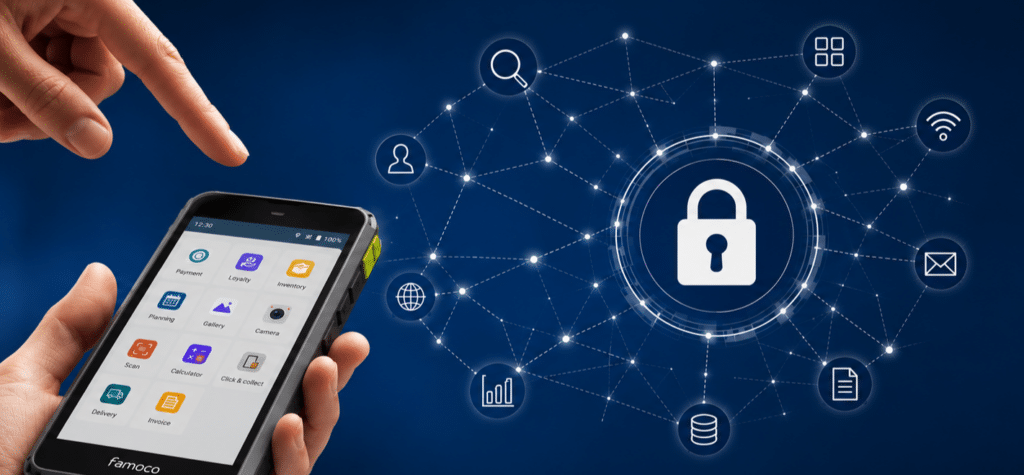
Famoco is part of this movement with an integrated approach. Rather than assembling independent components from multiple suppliers, Famoco has chosen to develop a complete solution in which every component works together as part of a coherent ecosystem: professional devices, a secure operating system, an MDM platform and management tools.
Famoco OS provides a sovereign Android environment that enables business applications to operate within a controlled framework on hardened devices, without relying on consumer services or mixing personal and professional use. Through this secure Android environment, organizations can reduce technological dependencies, limit exposure and maintain tighter control over device usage.
This control is extended through the Mobile Device Management (MDM) platform. Beyond fleet management (including deployment, configuration, updates and monitoring), it transforms technical field data into actionable insights for managing operations, such as geolocation, battery levels and last activity. It also enables organizations to remotely support operational teams through features including remote control and messaging. Organizations therefore gain real-time visibility over their equipment, can automate certain actions, monitor tool adoption, support their teams and optimize performance.
Conclusion: towards a more resilient, strategic and independent industry
For a long time, digital sovereignty was primarily viewed as a matter of protection. Today, it is becoming a strategic issue.
Against this evolving backdrop, on April 23, the French government announced its decision to move away from the cloud infrastructure of a major U.S. technology company for hosting the Health Data Platform (PDS), which brings together pseudonymized data from millions of French citizens for research purposes. By choosing to transfer this data to a French provider, the government described the move as a “strategic choice to strengthen security, trust and our technological independence.”
Organizations that succeed in maintaining end-to-end control over their data will gain a lasting competitive advantage. Security is no longer an end in itself: it is the foundation that enables organizations to turn data into a driver of performance.
Would you like to secure your mobile infrastructure and regain control over your field data?
Contact our Famoco experts to discuss your sovereignty challenges and discover solutions tailored to your needs.
FAQ: Everything you need to know about industrial and digital sovereignty
1. What does industrial sovereignty mean in the digital context?
It is an organization’s ability to maintain control over its production tools and information flows without depending on decisions or technologies imposed by foreign powers or dominant third-party providers.
2. Is a sovereign solution compatible with my existing Android applications?
Yes. Systems such as Famoco OS are based on Android (AOSP), allowing standard business applications to run in a more secure environment without advertising trackers or unnecessary background processes.
3. What data is actually collected by a sovereign MDM platform?
Only technical data required for the proper operation and maintenance of the fleet is collected, such as battery level, OS version and memory status. Data contained within business applications—such as identities or transactions—is not accessible through the management platform.
4. How can service continuity be ensured in areas without network coverage?
By using technologies such as NFC smart cards and devices capable of operating offline. Data is securely stored on the device and synchronized as soon as a connection becomes available.