
In a world where everything seems to be going digital, where smartphones are becoming our wallets and transport passes, one technology continues to thrive and grow: the smart card. Paradoxically, while cyber threats continue to rise, with the French National Cybersecurity Agency (ANSSI) reporting 3,004 cybersecurity incidents in 2024, the need for a secure physical credential has never been stronger.
Why, in the era of digital-first services, do organizations continue to invest in smart cards? Far from being just a piece of plastic, NFC smart cards remain a fundamental building block of digital trust, ensuring security and inclusion where smartphones alone are not enough.
1. A vulnerable world: why maintain a physical anchor?
One might assume that smartphone wallets will eventually replace everything. However, field realities tell a different story. In sectors such as identity, humanitarian aid, and healthcare, full dematerialization presents several critical limitations:
- Digital divide and inclusion: Not everyone owns a recent NFC-enabled smartphone. Enforcing a mobile-only approach means excluding part of the population, including elderly people, low-income communities, and individuals living in remote areas.The physical card remains the only truly universal tool.
- Technical reliability: A smart card has no battery. It never runs out of power, is not affected by software update failures, and works instantly. For a field worker or a patient in a healthcare facility, this constant availability can be critical.
This reality partly explains the continued growth of the industry. According to Mordor Intelligence, the global smart card market is expected to reach $30.6 billion by 2030.
2. What is an NFC Smart Card?
Unlike traditional chip cards where the chip is visible, the cards deployed by Famoco are contactless NFC cards with the technology completely embedded within the card itself.
An invisible digital vault
Don’t be fooled by its simple appearance. A smart card is not an inert piece of plastic like an old magnetic loyalty card. It contains a Secure Element: a tiny computer capable of securely storing secrets and performing cryptographic operations.
The key difference from conventional storage systems is that it operates in a closed and secure environment. Sensitive information such as cryptographic keys, identities, and entitlement balances remains locked inside the card. Even if the card is stolen, extracting and cloning this information is extremely difficult, if not impossible. This is known as a tamper-resistant architecture: a digital vault designed to protect data integrity against both physical and logical attacks.
The key advantage: offline operation
One of the greatest strengths of smart card technology is its ability to function without internet connectivity. Smart cards can authenticate users, validate entitlements, and deduct balances entirely offline. Transactions are stored locally on terminals and synchronized later when connectivity becomes available. This capability is indispensable in remote areas, connectivity blackspots, and emergency situations.
3. Real-world applications: three practical use cases
Far from being a theoretical technology, smart cards improve the daily lives of millions of users by simplifying interactions while securing access rights.
Famoco Smart Cards are based on JavaCard technology, enabling multiple independent applications, known as applets, to coexist on a single card. Each applet operates within its own secure environment, isolated from the others through internal security mechanisms. This architecture allows multiple services and functions to be consolidated onto a single physical credential, providing users with the convenience of managing everything through one card.
Education: one card for the entire student journey
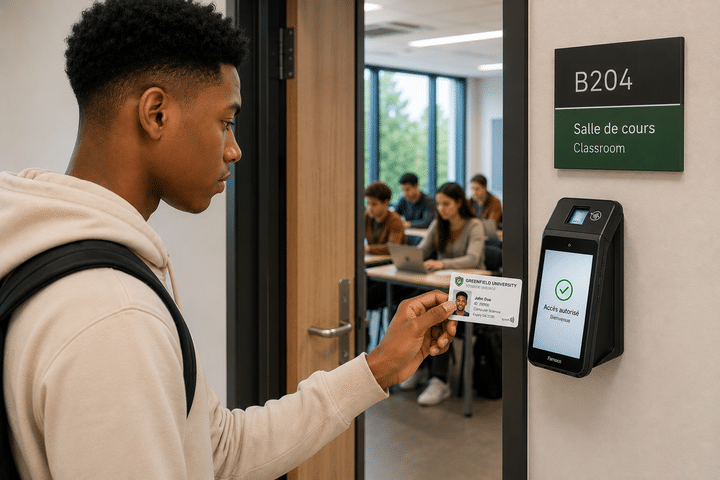
In educational institutions, student safety and operational efficiency are top priorities. The smart card becomes the student’s single credential for multiple services:
- Security: Controlling access to buildings and rooms (computer labs, etc), and restricted areas to prevent unauthorized entry.
- Closed-Loop Payments (Cashless): No cash handling on campus. Parents top up accounts online, and students pay for meals using their cards.
- Student Services: Library borrowing, photocopying services, and other campus resources.
A single card replaces keys, cash, and various administrative documents.
Healthcare: secure and controlled access to medical information
How can healthcare providers access a patient’s medical history while ensuring that only relevant information is shared with different stakeholders? The Secure Access Module (SAM), integrated into Famoco terminals, enables fine-grained access management when reading healthcare cards.
Through secure protocols, the card can identify who is requesting information. A doctor may access the full medical record to update a diagnosis, while administrative staff can only view the information necessary for billing purposes. This ensures patient confidentiality while helping prevent healthcare fraud.
Humanitarian aid: delivering assistance to the last mile
This is arguably one of the most critical use cases. In refugee camps and crisis areas, internet connectivity and banking infrastructure are often unavailable.
Governments and NGOs are replacing paper vouchers, which are fragile and easy to counterfeit, with NFC smart cards.Famoco has deployed more than 22 million cards for humanitarian aid programs.The process is fully inclusive:
- Beneficiary Enrollment in the Field: Cards are distributed and personalized directly on-site, including the registration of beneficiaries and their biometric information.
- Biometric Authentication: Beneficiaries do not need to remember PIN codes. Fingerprint verification, either stored on the card or verified through the terminal, authorizes transactions.
- Electronic Vouchers: Cards can store digital vouchers redeemable for food and essential goods through local merchants equipped with mobile terminals.
- Full Traceability: Aid organizations can verify that assistance reaches the intended recipient, significantly reducing fraud and eliminating “ghost beneficiaries.”
Famoco: 10 years of expertise driving security, interoperability, and innovation
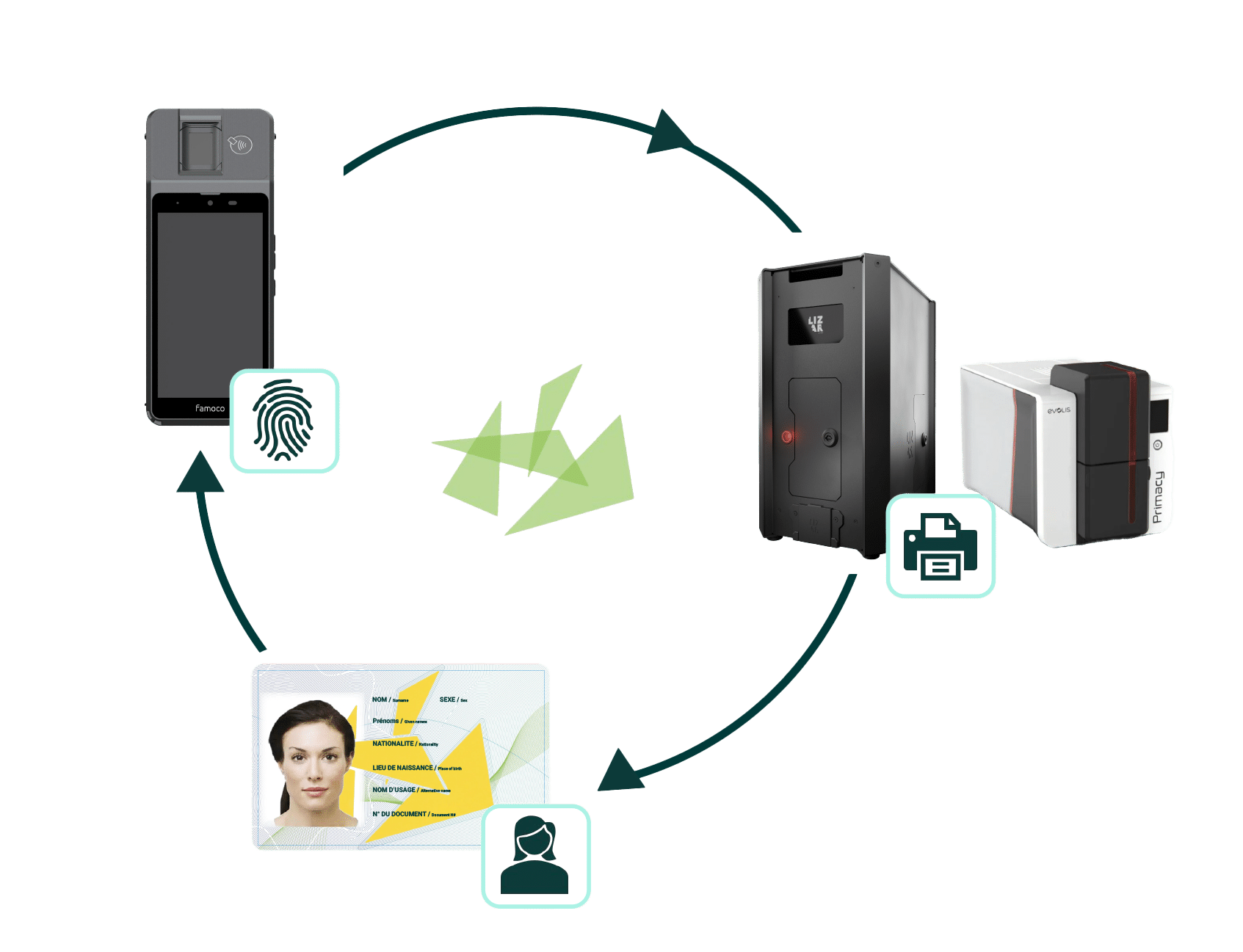
Famoco is more than a hardware provider. We control the entire value chain through our PRYSM ID offering, a complete end-to-end identity ecosystem that includes:
- Biometric devices (Famoco Digitouch)
- Secure credentials (Famoco Smart Cards)
- Field personalization through laser or thermal card printing
- A fully secure environment powered by a sovereign operating system (Famoco OS)
- Connectivity and centralized fleet management through our MDM platform
An integrated ecosystem where every component has been designed from the ground up to work seamlessly together.
Our approach also supports innovations such as Match-on-Card (MoC), enabling biometric verification directly within the card itself. The principle is based on comparing two biometric templates: the reference template captured during enrollment and the template generated from the user’s fingerprint at the time of authentication. Because this verification occurs directly on the card, biometric data remains protected within a secure environment and never needs to be transmitted to an external server.
Conclusion: sovereignty at your fingertips
Smart cards are not a technology of the past. They are the essential trust bridge between the physical and digital worlds. They enable organizations to maintain control over their data, guarantee access to services for all, and protect user rights against fraud. Whether your project involves digital identity, closed-loop payments, access control, or citizen services, secure smart card technology remains a proven and future-ready solution.
Looking to launch a secure and inclusive digitalization project? Whether your needs involve identity, cashless payments, access management, or humanitarian aid distribution, our experts are ready to help. Contact us to discuss your project.
FAQ: Frequently asked questions about Smart Cards
Why choose a Smart Card instead of a QR Code?
It comes down to security and convenience. A QR code can easily be copied, photographed, or duplicated, making identity fraud easier. A smart card contains a secure chip that cannot simply be replicated. Additionally, NFC card interactions are nearly instantaneous—typically under one second—whereas QR code scanning requires sufficient lighting, a clean display surface, and proper camera focus.
Can one card support multiple services?
Absolutely. A smart card functions like a miniature computer with separate secure compartments. One application can manage physical access control while another independently manages cafeteria payments. A security issue affecting one application would not compromise the others.
What happens if there is no internet connection?
The system continues to operate. Unlike cloud-only solutions, smart cards store rights, balances, and credentials directly within the chip. Transactions can be processed offline, and the terminal will synchronize data with the central server as soon as connectivity is restored.